Top Lead Generation Strategies for Real Estate Businesses 2026
91% of marketers rate lead generation as their number one goal, yet 61% say generating traffic and leads is their biggest challenge. The gap between those two facts is where most real estate businesses lose. This blog breaks down the real estate lead generation strategies that actually work in 2026, also explains what they are, how to build them and what to measure.
What Is Real Estate Lead Generation?
Real estate lead generation is the process of identifying and attracting potential buyers, sellers or investors and moving them toward a sales conversation. A lead can come from a portal enquiry, a Facebook ad, a referral, an open house, or a WhatsApp message. What matters is that the person has expressed some level of interest in buying or selling a property.
Not all leads are equal. Referral leads convert at 14 - 20% while portal-specific leads convert at just 0.4 to 1.2%. Understanding where your leads come from and what each source is realistically worth is the starting point for building a strategy that actually produces results.
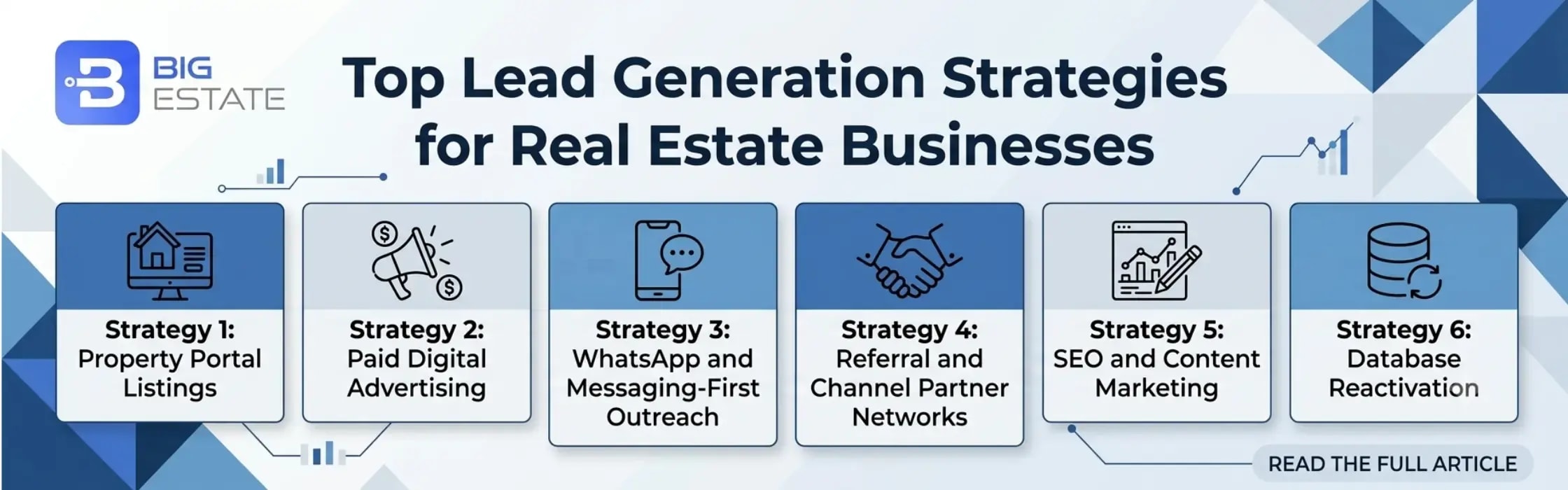
Top Real Estate Lead Generation Strategies in 2026
Strategy 1: Property Portal Listings
Strategy 2: Paid Digital Advertising
Strategy 3: WhatsApp and Messaging-First Outreach
Strategy 4: Referral and Channel Partner Networks
Strategy 5: SEO and Content Marketing
Strategy 6: Database Reactivation
Comparison Table: Real Estate Lead Generation Strategies
| Strategy | Cost Per Lead | Conversion Rate | Time to Results | Best For |
|---|---|---|---|---|
| Property portals | Low–medium | 0.4- 1.2% | Immediate | High volume, price sensitive buyers |
| Google Search Ads | $53–66/lead | 5- 10% | Immediate | Active, high-intent buyers |
| Facebook / Instagram Ads | $26/lead | 1- 3% | 1- 2 weeks | Early-stage awareness, younger buyers |
| WhatsApp outreach | Very low | Varies by list quality | Immediate | India-first buyer communication |
| Referrals / channel partners | Near zero | 14- 20% | 1- 3 months to build | Long-term, high conversion pipeline |
| SEO / content | Low (time cost) | 3.2% organic avg | 3- 6 months | Cost-efficient long-term growth |
| Database reactivation | Near zero | 3- 4x purchased leads | Immediate | Existing warm leads going cold |
Benefits of a Structured Lead Generation Approach
Benefit 1: Lower Cost Per Acquisition
When you know which channels convert at what rate, you stop spending money on sources that don't justify. Most developers who track CPL by source find that 20% of their channels are generating 80% of their closings.
Benefit 2: Predictable Pipeline
You know how many leads are needed at the top to produce a given number of closings at the bottom and you can plan spend accordingly.
Benefit 3: Better Lead Quality Over Time
The more data you collect on which lead sources produce buyers who actually close, the better your targeting gets. CRM here works as a feedback loop that improves every campaign you run.
Challenges in Real Estate Lead Generation
- Lead Leakage: Enquiries fall through the cracks when communication happens in personal WhatsApp accounts or isn't logged in a CRM.
- Slow Response Times: The industry average of 15+ hours before first contact is a problem no amount of ad spend can fix.
- Poor Lead Quality from Paid Sources: Facebook and portal leads require heavy nurturing and teams abandon them too early.
- No Follow-Up System: Most buyers take 5 to 12 touches before making a decision; most sales teams stop after 2 to 3.
Best Practices for Real Estate Marketing Ideas That Convert
- Respond to every new lead within 5 minutes.
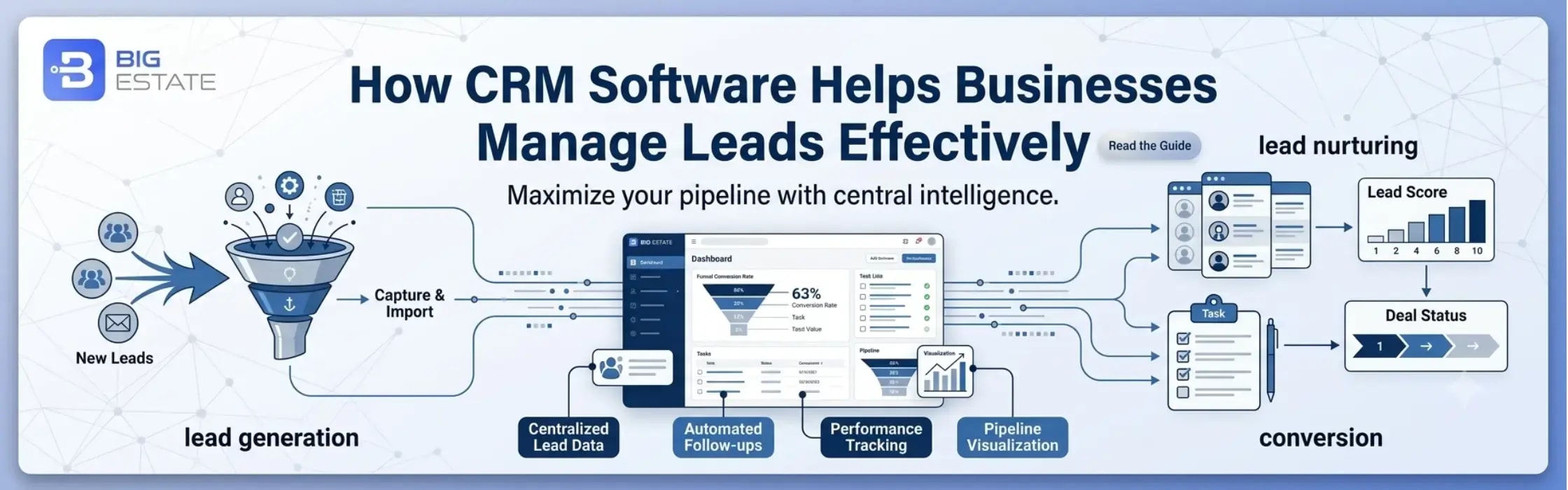
- Use a single CRM where every conversation, like calls, WhatsApp, and emails, is logged automatically.
- Score leads by intent so sales representatives prioritise the ones that are most likely to convert.
- Never use a personal WhatsApp account for buyer communication.
- Track cost per lead AND cost per closing by channel.
How Different Developers Use These Strategies
Large developer with multiple projects
Typically runs paid ads for each project separately, uses portal listings for volume, manages a channel partner network for high-conversion referrals and uses a platform like BigEstate to auto-capture portal leads, respond via WhatsApp within 60 seconds, and track CPL by project independently.
Mid-size developer with one or two projects
Relies more heavily on portals and a smaller paid ads budget. The biggest leverage here is usually response speed and WhatsApp follow-up quality.
Small broker or boutique agency
Referrals and SEO tend to be the most cost-efficient channels. Database reactivation from past clients is the highest-converting activity available at zero cost.
Key Takeaways
- Real Estate lead generation strategies that work in 2026 combine fast response, structured nurturing and channel-specific targeting.
- Referral and channel partner leads convert at 14- 20%; portal leads at 0.4 to 1.2%.
- Property lead generation in India is WhatsApp-first - any strategy that doesn't account for this is working against buyer behaviour.
- Database reactivation is the most underused real estate marketing idea available, with 3- 4x the conversion rate of purchased leads.
- 78% of buyers work with the first agent who responds, meaning that speed-to-lead is a bigger variable than lead volume.
- A CRM that logs every interaction is the infrastructure that makes every other strategy work properly.
Conclusion
Real Estate lead generation strategies don't need to be complicated. The businesses that are closing the most deals aren't the ones spending the most on advertising; they're the ones with the fastest response times, the clearest sales funnels and the best follow-up systems.
Ready to build a faster and more structured lead pipeline? Big Estate's purpose-built CRM for Indian real estate developers handles lead capture, WhatsApp follow-up, portal auto-import and multi-project pipeline management in one place which is designed specifically for the way Indian buyers actually behave.
Also Read: AI Lead Generation: How Businesses Can Automate Customer Acquisition